
New VLBI Observation Reveals a Rare, Compact, Fading Jet in an Intermediate-Mass Black Hole Merger System
Intermediate-mass black holes (IMBHs, ~10² - 10⁶ M☉) bridge the gap between stellar-mass and supermassive black holes. They are crucial for understanding key scientific questions, such as the growth of black hole mass and the co-evolution of black holes with galaxies. However, fully confirmed IMBHs remain extremely rare. Dwarf galaxies, characterized by their low luminosity and low mass, represent important sites for detecting IMBHs.
Using the European VLBI Network (EVN) observations, LI Chao, a PhD student at the Xinjiang Astronomical Observatory of the Chinese Academy of Sciences (XAO), along with his supervisor Prof. CUI Lang and their domestic and international collaborators, conducted a dedicated study of the nearby dwarf galaxy merger system SDSS J101747.09+393207.7 (also known as RGG66).
The researchers successfully detected a milliarcsecond-scale, compact non-thermal radio component. Combining this with historical data, they inferred it to be a rare compact, fading radio jet driven by an intermediate-mass black hole, providing new clues for understanding how galaxy mergers trigger black hole accretion and black hole mass growth. The results were published in Astronomy & Astrophysics (A&A, 710, L22, 2026).
The detected compact radio component has a total flux density of 0.41 mJy and a brightness temperature of approximately 6 × 10⁶ K. By combining data from radio surveys including LoTSS, RACS, VLASS, NVSS, and FIRST, the researchers reconstructed the source's radio activity history over the past approximately 30 years: the source remained undetected in radio surveys during the 1990s, was first detected in the 2015 LoTSS survey, and has since shown a continuous decline in flux density. Fitting multi-band radio survey data yielded a spectral index of α ≈ −1.15 and a fading timescale of approximately 8 years; its flux density is expected to drop below 0.1 mJy at 5 GHz in about 12 years.
Based on its steep radio spectrum, continuously declining flux, and evolutionary characteristics over the past nearly 30 years, the researchers identified the milliarcsecond-scale radio component as a young, short-lived jet produced by unstable accretion onto the central black hole, which will gradually fade away over the coming decades. Previously, only six IMBH candidates with parsec-scale jet structures had been detected by VLBI, and none of their host galaxies showed signs of a merger. The X-ray to Eddington luminosity ratio of RGG66 is approximately 0.1, which is the highest among all known VLBI-detected IMBH accretion systems, and its compact morphology suggests an extremely early stage of jet activity.
This research was supported by the National Natural Science Foundation of China and the National Key R&D Program of China.
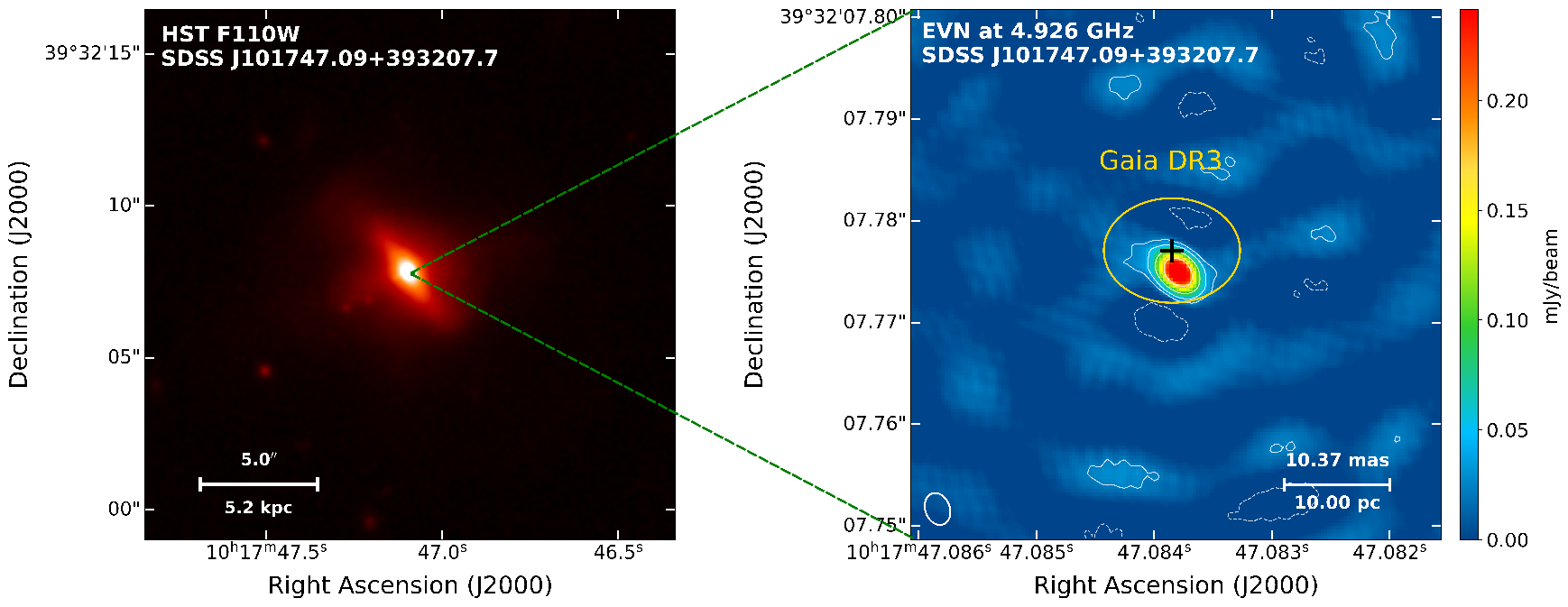
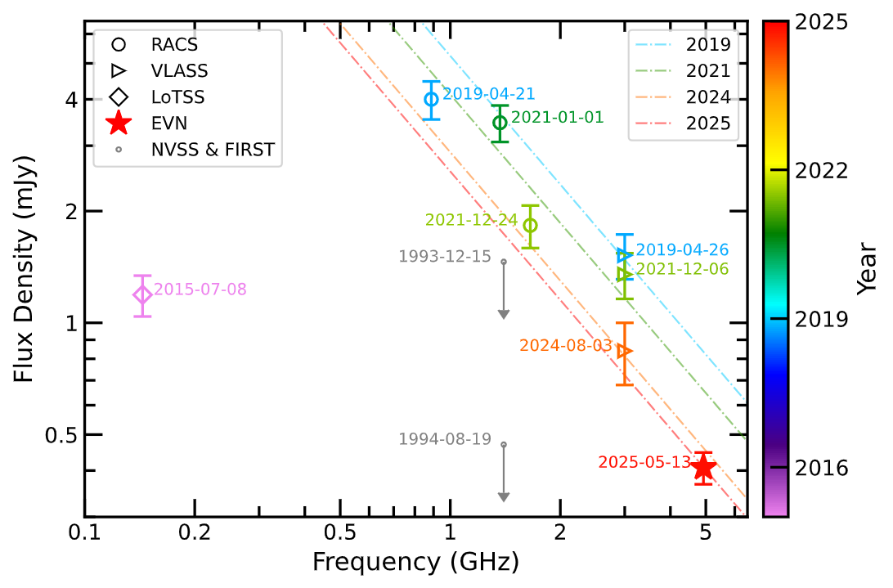
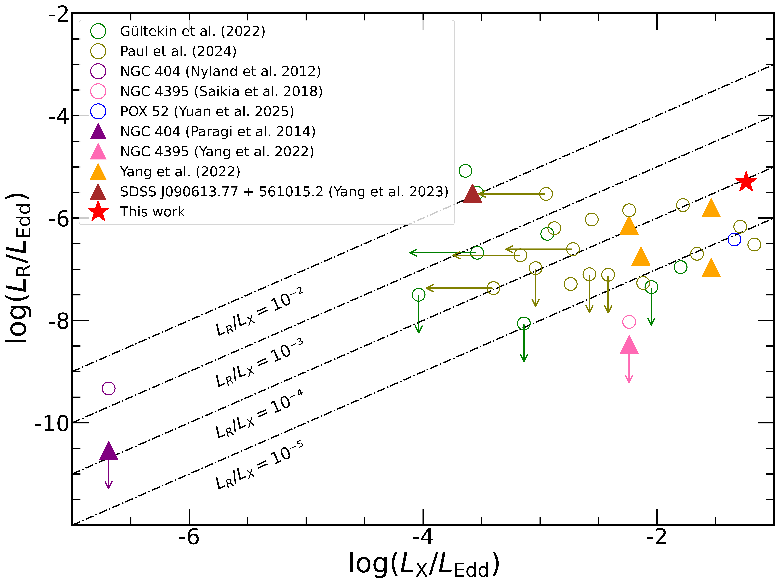
Top left: HST imaging of RGG66 with the F110W infrared filter. Top right: EVN image of RGG66 at 4.926 GHz. The black cross marks the optical position from Gaia DR3; the semi-major and semi-minor axes of the yellow ellipse represent the total 1σ uncertainties. Bottom left: Radio spectra of RGG66 from non-simultaneous observations. The dashed lines show the temporal spectrum model S(ν,t), with the colors of these lines and the data points denoting the year of observation. Gray points represent 3σ upper limits from NVSS and FIRST. Bottom right: LR/LEdd − LX/LEdd plane. Triangles denote radio luminosity measurements obtained using VLBI. Arrows indicate that the corresponding data points are upper limits.
Attachment Download:





