
Cosmic Duet:When a Pulsating Star Meets Tidal Locking
About 467 light-years away, a stellar system designated TIC 197757000 is performing a cosmic dance—two stars orbiting each other every 2.2 days. Now, a team led by Ph.D. student Shahidin Yaqup and his supervisor Prof. Ali Esamdin at the Xinjiang Astronomical Observatory, Chinese Academy of Sciences, has unveiled the secrets of this system using data from NASA’s TESS space telescope and ground-based observations. Related results were published in the journal Research in Astronomy and Astrophysics.
What makes this binary special is that one of its components is a δ Scuti pulsating star—a class of stars that rhythmically “beat” with periods of just a few hours. When such a pulsator resides in a close binary, the gravitational pull from its companion can dramatically reshape its pulsation behaviour.
The researchers first used spectroscopy to measure the primary’s temperature, then performed orbital fitting with high-precision TESS and multi-band ground photometry to constrain the masses and radii of the binary stars. The derived key physical parameters are as follows: the primary has Teff ≈ 7782 K and M = 1.78 solar masses, and the secondary has Teff ≈ 4409 K and M = 0.98 solar masses.
Using analytical methods including Fourier transforms, autocorrelation functions and echelle diagrams, we measured a large frequency separation of 33.45 uHz. This separation acts as a unique pulsation fingerprint of the star, which enables us to calculate the stellar mean density and provides evidence for investigating the star’s internal structure. The mean density derived from the large frequency separation shows excellent agreement with that computed via the binary star model parameters, which validates the reliability of the binary model analysis.
Three lines of evidence—the short orbital period, ellipsoidal distortions in the light curve, and the presence of orbital harmonics in the pulsation signals—all point to a single conclusion: TIC 197757000 is a tidally synchronized system. This work not only provides a valuable benchmark for stellar interior studies but also opens a new window into how tidal locking influences the pulsation behaviour of stars in close binaries.
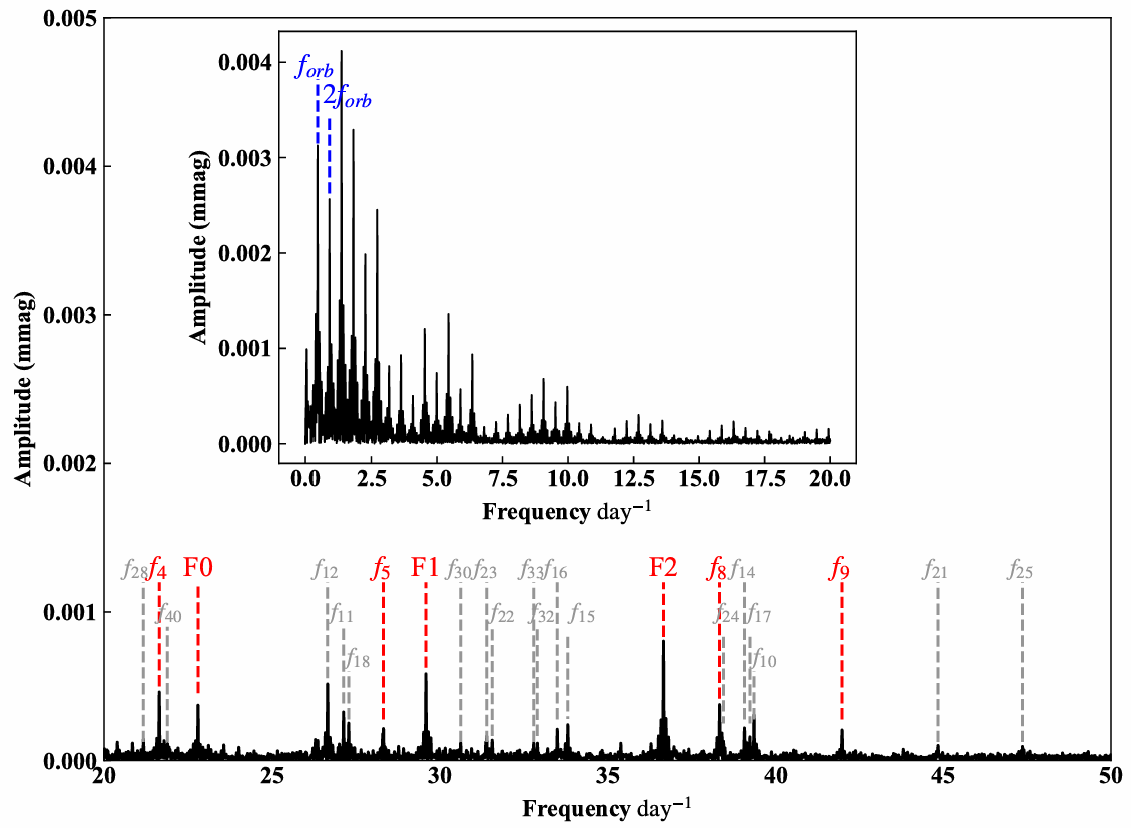
Pulsation frequency spectrum diagram of TIC 197757000
Attachment Download:




