
Probing the Central Engine of Supermassive Black Holes throughJet Magnetic-field Measurements of Blazar 1156+295
In the vast depths of the universe, blazars, with their extreme relativistic jets pointing directly at Earth, act as cosmic energy hubs connecting supermassive black holes (SMBHs) to the vast cosmic environment. However, the physical driving engines and radiation mechanisms behind these plasma torrents, which are launched outwards at nearly the speed of light, have long remained a core puzzle to be deciphered in modern high-energy astrophysics.
Recently, XU Wancheng, a Ph.D. student at the Xinjiang Astronomical Observatory (XAO) of theChinese Academy of Sciences, under the supervision of Prof. CUI Lang, successfully revealed the physical picture of magnetically driven shocks deep within the jet of blazar 1156+295. The related research findings have been published in The Astrophysical Journal.
The researchers conducted an in-depth joint analysis of the radio flaring periods of 1156+295 by utilizing multi-frequency monitoring data from the 100-meter Effelsberg radio telescope in Germany and multi-epoch images from Very Long Baseline Interferometry (VLBI). Through synchrotron self-absorption (SSA) spectral modeling, the researchers accurately extracted the spectral turnover frequency and turnover flux density. By combining these with the core size and brightness temperature derived from quasi-simultaneous VLBI images, they quantitatively reconstructed the long-term evolutionary trajectories of the jet's magnetic field strength and magnetic flux.
The analysis indicates that the blazar's radio variability, fine structural evolution of the jet, SSA spectral variations, and inner-jet magnetic field properties exhibit a high degree of temporal connection and physical coupling.
The researchers combined these results with theoretical models and foundthat the release of magnetic energy within the jet precedes the radio flares in time, and the inferred magnetic flux is able to reach the theoretical threshold of a magnetically arrested disk (MAD). This series of multi-level dynamic physical processes is highly consistent with the theoretical expectations of the magnetically driven jet scenario and the shock-in-jet model.
This study places the radio variability, magnetic field measurements, spectral evolution, and inner-jet structural dynamics of the blazar onto a common timeline framework, providing crucial observational evidence for understanding the launching, energy transport, and driving mechanisms of powerful jets in active galactic nuclei (AGNs).
Furthermore, it fully highlights the immense value of combining multi-frequency single-dish monitoring with high-resolution, multi-epoch VLBI observations in exploring the "magnetic engines" of AGN jets and their extreme plasma physical processes.
This work was supported by the National Key R&D Program of China.
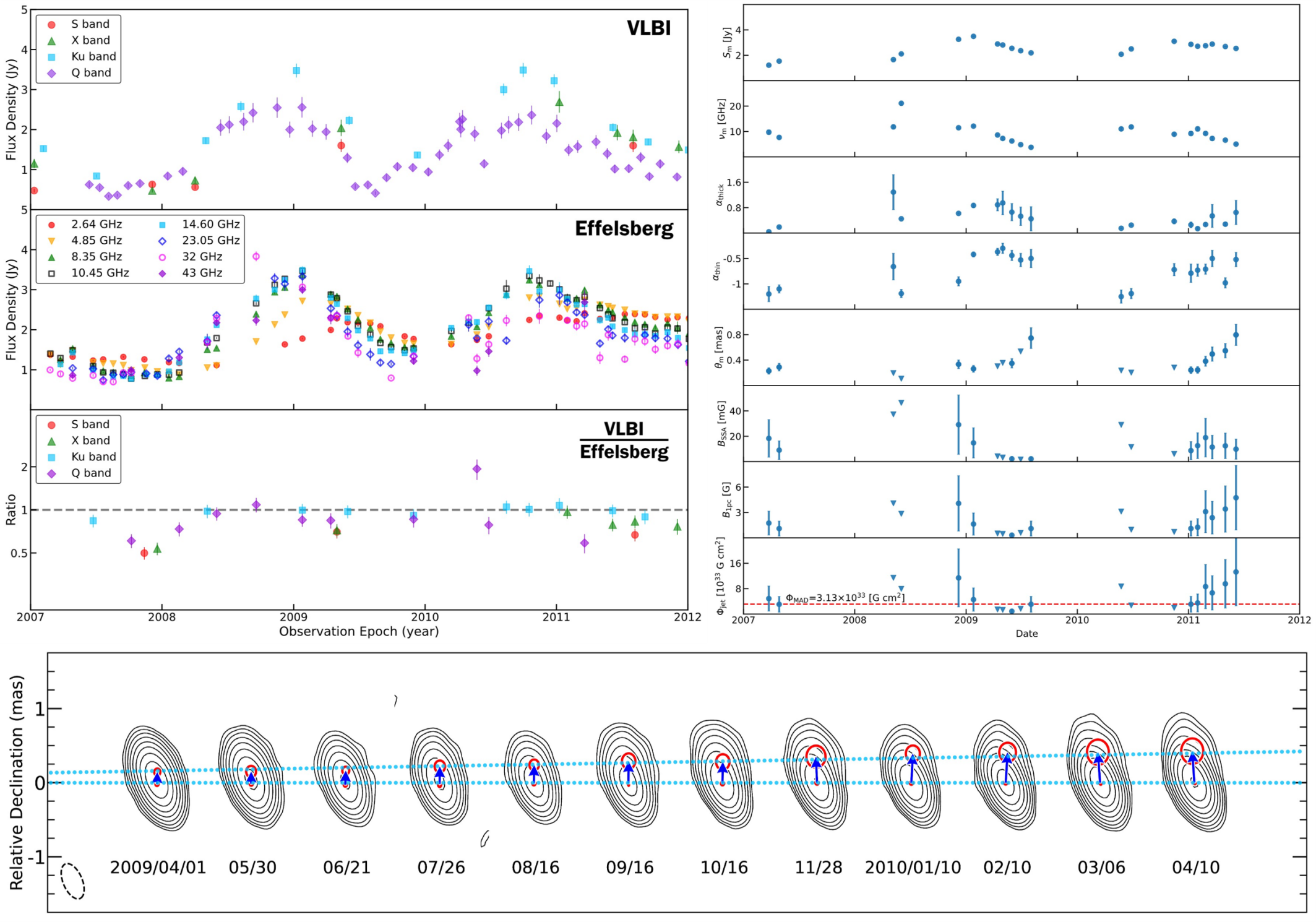
Figure 1: Top left panel: VLBI and single-dish radio flux density curves of the blazar 1156+295 from 2007 to 2012. The flux ratio of nearly unity indicates that the radio emission is core-dominated. Top right panels: Evolution of the derived magnetic field parameters. From top to bottom, the panels display the SSA turnover frequency, turnover flux density, optically thick spectral index, optically thin spectral index, emission region size, magnetic-field strength, normalized magnetic-field strength at 1 pc, and magnetic flux. Notably, the jet magnetic flux intermittently reaches or exceeds the magnetically arrested disk (MAD) threshold during the evolution. Bottom panels: VLBI images from 2009 to 2010 clearly reveal the continuous motion of the jet component.
Attachment Download:





