
A Rapid Spin-down Millisecond Pulsar Puts Stringent Constraints on Classical Theory of Millisecond Pulsar Formation
A research team led by Prof. WANG Na from the Xinjiang Astronomical Observatory (XAO) of the Chinese Academy of Sciences (CAS) conducted in-depth observations of PSR J0435+3233 using the Five-hundred-meter Aperture Spherical radio Telescope (FAST).
PSR J0435+3233 is a millisecond pulsar with an abnormally high spin-down rate that is two orders of magnitude greater than that of any other millisecond pulsars in the Galaxy. These characteristics place the pulsar far above the "spin-up line" in the period versus period-derivative diagram (P-Ṗ diagram), distinctly separating it from all known millisecond pulsars. It also displays significant timing noise and an unusual orbital variation rate, suggesting the possible presence of a third celestial body in the system.
The results of this research pose a direct challenge and impose stringent constraints on the classical accretion induced spin-up formation theory for millisecond pulsars. The results have been published in Nature Astronomy.
Conventional theory posits that millisecond pulsars are formed in “recycling“ through accreting matter from a binary companion, thereby gaining angular momentum and spinning up their rotation periods to milliseconds. A crucial information for understanding the evolutionary history can be gained from the pulsar’s position in the P-Ṗ diagram, particularly its distribution relative to the "Eddington spin-up line". The latter corresponds to the point where the released radiation pressure is balanced with the gravity during the accretion process. It represents the maximum stable accretion rate that a neutron star can sustain, namely the Eddington accretion rate.
Observations to date have shown that all previously discovered binary millisecond pulsar systems lie below the "spin-up line," which is fully consistent with theoretical expectations. However, the existence of PSR J0435+3233 strongly suggests that the formation of millisecond pulsars may not follow a single accretion spin-up channel, but instead may involve multiple physical mechanisms that were previously insufficiently understood.
Typical millisecond pulsars generally possess old age, weak magnetic fields, and stable rotation. These features, confirmed by observations of numerous binary systems and millisecond pulsars, make them the most accurate “clocks” in the universe. On the contrary, PSR J0435+3233 has a significantly younger characteristic age and markedly higher surface magnetic field.
The researchers speculate that special processes such as "super-Eddington accretion onto a neutron star with a strong magnetic field" or "accretion-induced collapse of a magnetized white dwarf" could potentially explain the formation of such young millisecond pulsars that exhibit high spin-down rates, strong magnetic fields, and high energy loss.
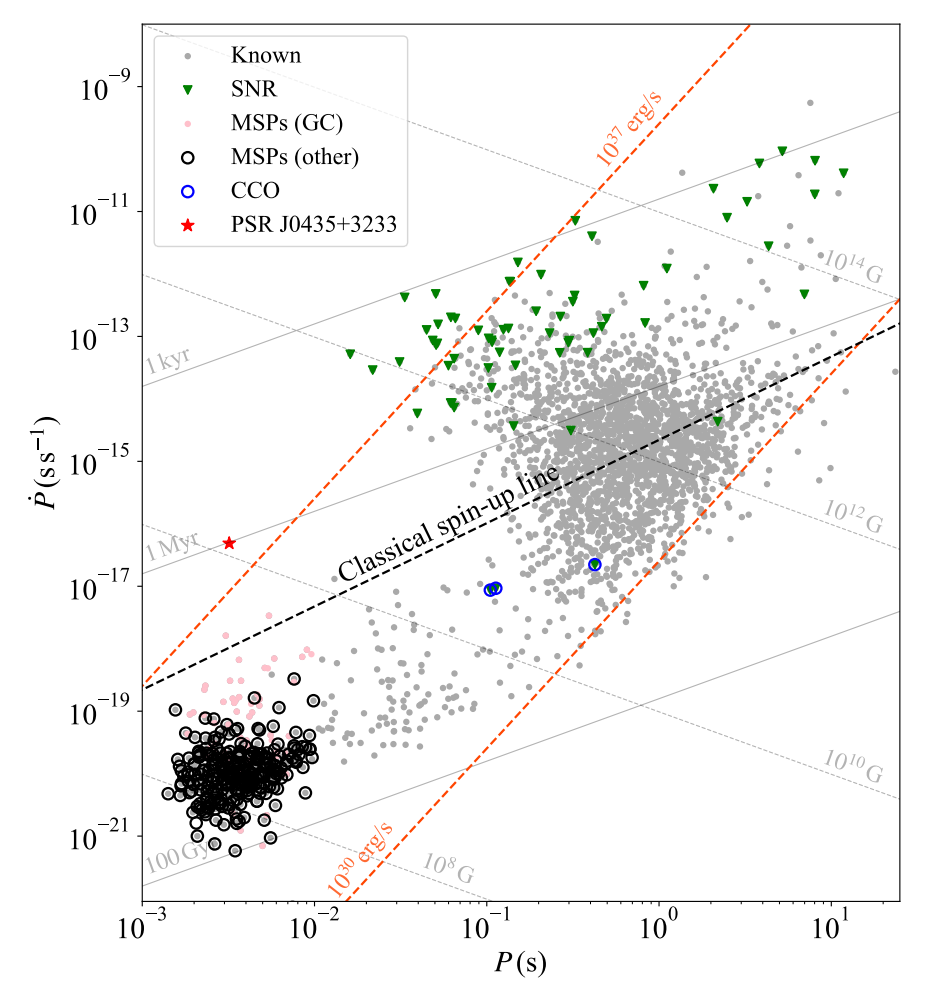
P-Ṗ diagram of known pulsars and PSR J0435+3233.
Article link: https://www.nature.com/articles/s41550-026-02836-3.
Attachment Download:




